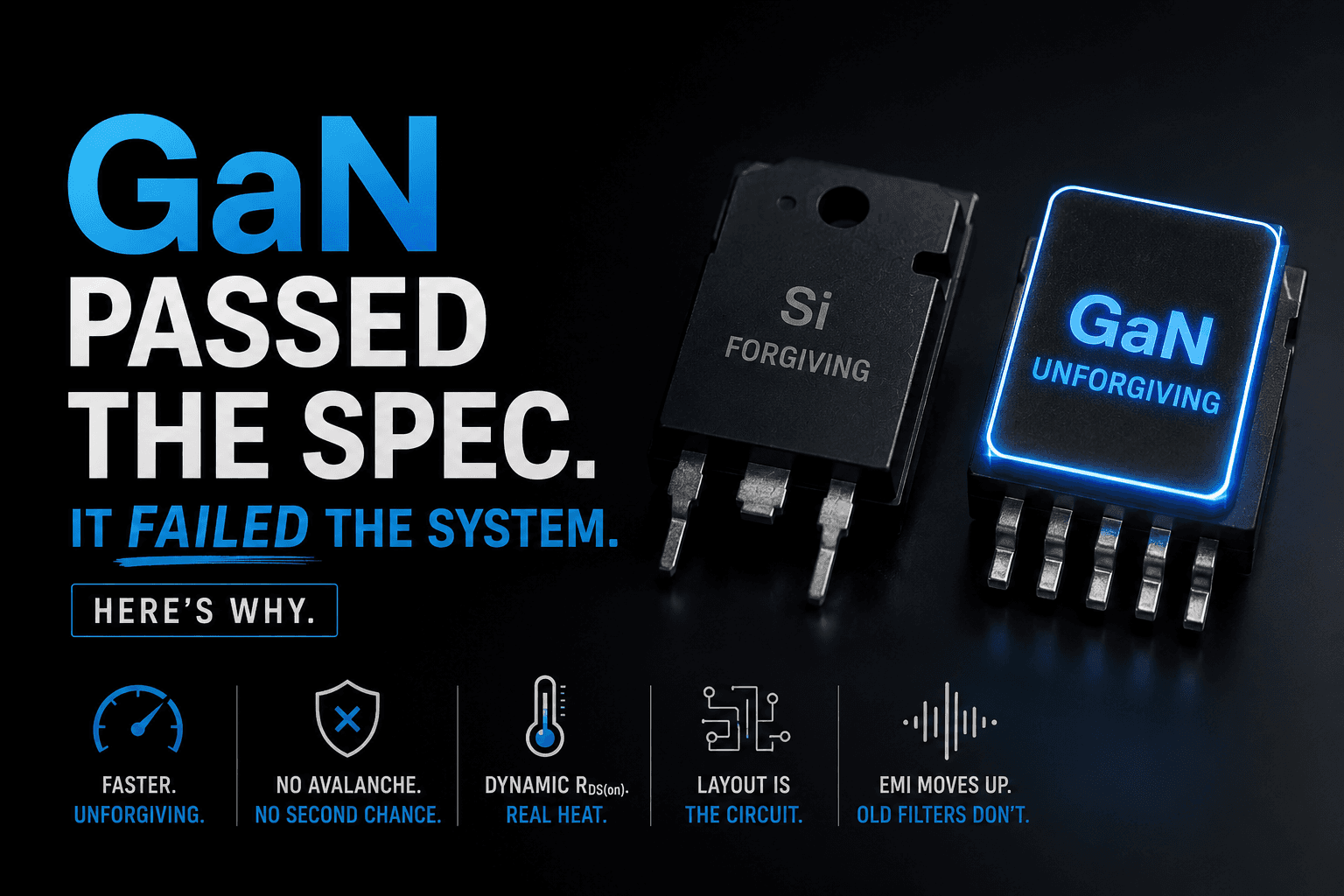
Silicon taught us habits. GaN does not honor them.
Everyone is switching to GaN. Chargers, power supplies, motor drives, onboard converters. The datasheet promises higher efficiency, smaller magnetics, faster switching, less heat. All of it is true.
And then the design that hit every efficiency target on the bench starts failing in the field.
Because GaN does not fail the way silicon fails. The part met its spec. The system was never designed for what the spec implied.
Faster edges are the feature. They are also the problem.
The reason GaN is efficient is the same reason it is unforgiving. Switching transitions that used to take tens of nanoseconds now take a few. That speed is the whole point.
It is also a high dV/dt and dI/dt event happening right next to everything else on the board.
Parasitic inductance you ignored at 100 kHz now rings violently.
Gate loops that were fine on silicon overshoot and stress the gate.
Common mode currents find every stray capacitance to ground.
EMI moves up into bands your old filter was never sized for.
None of this shows up in a steady state measurement. It shows up on a fast scope probe, or in an EMC chamber, or in a customer's enclosure six weeks later.
GaN has no avalanche rating. Silicon forgave you. GaN will not.
A silicon MOSFET could absorb a transient spike into avalanche and survive. Engineers leaned on that margin for years without naming it.
GaN does not avalanche. Exceed the drain voltage rating for a moment and the part is simply gone. The transient that silicon shrugged off is now a destructive event.
The design did not get worse. The hidden safety net got removed, and most layouts were quietly relying on it.
Dynamic on resistance is not on the front page of the datasheet.
A GaN device measured cold and slow looks excellent. Under real switching, at temperature, after a hard charge, the effective on resistance climbs. The phenomenon has a name and a curve, and it usually lives deep in the application note rather than the headline table.
Teams that size thermals from the typical static number find their loss budget was optimistic. The board runs hotter than the simulation promised, which feeds straight back into reliability.
The layout is the circuit now.
On silicon, layout was a constraint. On GaN, layout is a parameter.
Loop inductance in the power and gate paths directly sets your overshoot, your ringing, and your switching loss. A schematic that is correct can still produce a board that is unstable because the copper between the parts is part of the design.
This is the trap. The schematic passes review. The layout passes DRC. And the physics that actually governs the part lives in geometry that neither review was looking at.
Most GaN failures are silicon assumptions in disguise.
The failures are rarely about GaN being exotic. They come from carrying silicon intuition into a part that does not share it.
Assuming an avalanche margin that no longer exists.
Assuming static on resistance describes a switching device.
Assuming the old EMI filter still covers the new spectrum.
Assuming layout is cleanup rather than design.
When the assumption is silicon and the part is GaN, the design breaks in exactly the place you stopped looking.
Reliability with GaN is engineered into the loop, not measured at the end.
Design the commutation loop first, then place everything else around it.
Respect the drain voltage rating as a hard wall, not a soft target.
Budget thermals from dynamic behavior, not the cold static figure.
Validate gate drive at temperature and at full speed, not at idle.
Size EMI control for the real edge rate, not the old one.
The efficiency comes for free. The reliability does not. It has to be built into the same loop that makes the part fast.
Final thought.
GaN is not harder than silicon. It is honest in places silicon was forgiving. Every margin you used to get without asking for it, you now have to design for on purpose.
The part will always pass its spec. Whether the system survives depends on whether your assumptions came from the datasheet or from a decade of silicon you never had to think about.